
Johnson Matthey opens first hydrogen internal combustion engine facility
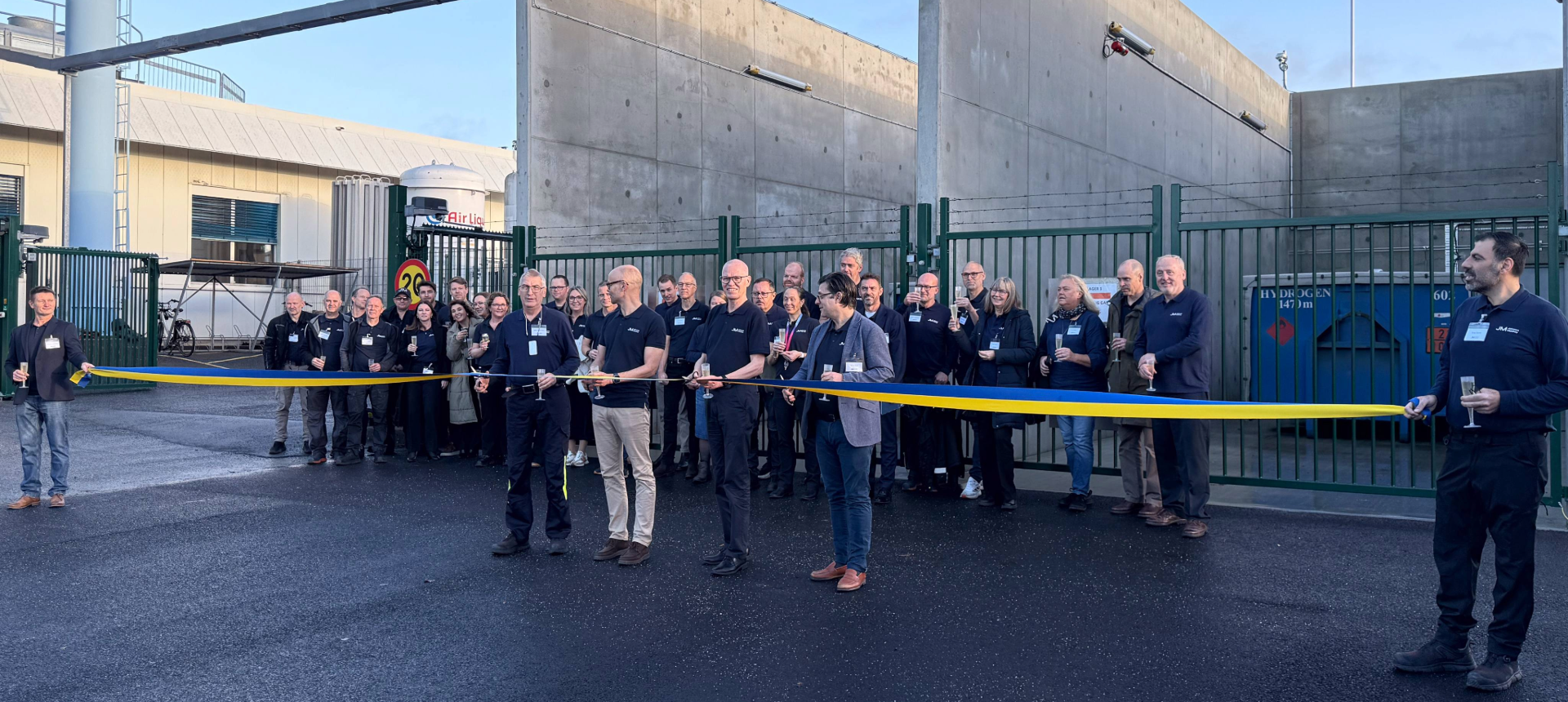
Johnson Matthey (JM) has officially opened its first hydrogen internal combustion engine (H₂ICE) facility, where cutting-edge emission control systems will be tested.
A global leader in sustainable technologies, JM has developed the new centre of excellence to strengthen its world-class heavy-duty vehicle testing capabilities.
H₂ICE uses zero carbon hydrogen fuel in tried-and-tested engine technology, presenting a viable path for decarbonising medium and heavy-duty transport, such as trucks and buses.
Announced back in July, the new testing area forms part of JM’s existing site in Gothenburg, Sweden. The facility has been completed on time and on budget, representing a £2.5m investment over three years. The opening was performed by Damien Sotty, JM R&D Director, Daniel Sandqvist, Gothenburg Test Centre Manager and Jonas Edvardsson, Managing Director JM Gothenburg.
The investment has further expanded JM’s H₂ICE testing capability, allowing us to test full engines for the first time. This supports the continued evolution of the global market and regulatory environment, while addressing the desire of JM’s extensive customer base in the transport sector to seek cleaner mobility solutions.
Tauseef Salma, JM Chief Technology Officer in Clean Air, said: “This investment shows JM is backing H₂ICE as a ready-to-go technology that will enable mobility partners to meet their decarbonisation and climate goals.
“Our state-of-the-art Gothenburg facility positions JM as a world leader in sustainable technology solutions, transforming energy and reducing carbon emissions.”
The new Gothenburg installation supports H₂ICE engines up to 600kW (800hp). It will test the performance of catalysts within the wider engine after-treatment and control systems, providing key insights into the development of hydrogen mobility solutions. Gothenburg is already home to medium and heavy-duty diesel engine test cells.
The H₂ICE investment follows on from JM’s collaboration with Cummins, and technology partners PHINIA and Zircotec, who launched Project Brunel in November 2021. This partnership was successfully concluded in March 2025, delivering proof points towards significant improvements in H₂ICE engine performance and durability.
The new Gothenburg H₂ICE facility includes:
An on-site hydrogen supply & storage area with compressor and intermediate storage tank
Hydrogen supply and storage up to 413 bar
Hydrogen flow meter and analyser, plus exhaust measuring instruments
All appropriate control, sensing and safety systems
Tauseef Salma added: “For more than two centuries, JM has helped tackle some of the world’s biggest challenges. We continue to do so today because it’s in our DNA. The opening of this new testing facility shows our commitment to strategic partnerships to drive innovation, strengthening the potential of H₂ICE as a net zero pathway for commercial vehicles.”