New analysis of 2,500 EV warranty claims reveals a 23-fold difference in reliability between Britain's best and worst-performing used electric vehicles.
The Renault Zoe emerged as Britain's most reliable used EV, while the Tesla Model S generated warranty claims more than 23 times as frequently
Battery failures are no longer the biggest concern for used EV owners. Central locking systems are now the most common fault, while charger port repairs average almost £1,900
Specialist labour now accounts for almost one-third of the average EV repair bill, highlighting the changing cost of electric vehicle ownership
Choosing the right used electric vehicle could mean the difference between years of dependable motoring and repair bills running into thousands of pounds, according to new research from Warranty Solutions Group (WSG), which reveals some used EVs are more than 23 times more likely to generate a warranty claim than others.
Analysis of approximately 2,500 EV warranty claims, recorded between May 2025 and June 2026, has revealed significant differences in reliability between individual electric vehicle models, challenging the perception that all EVs deliver a similar ownership experience.
The research found that the most reliable model recorded a warranty claim rate of just 1.49%, while the least reliable exceeded 34%, meaning some used electric vehicles generated warranty claims at a rate more than 23 times higher than others.
The findings come at a pivotal time for the used EV market. Record numbers of former company cars and leased electric vehicles are now entering dealerships as manufacturer warranties begin to expire, making long-term reliability, repair costs and ownership expenses increasingly important considerations for buyers.
The questions consumers are asking have also changed. Five years ago, the conversation centred on battery range, charging infrastructure and whether electric vehicles were practical for everyday use. Today, buyers are increasingly asking which models are proving the most reliable, what typically goes wrong and how much repairs are likely to cost once the manufacturer's warranty expires.
WSG's claims data reveals there is no such thing as a "typical" used EV. Instead, it highlights significant differences between individual models, with some proving exceptionally dependable while others generate warranty claims far more frequently.
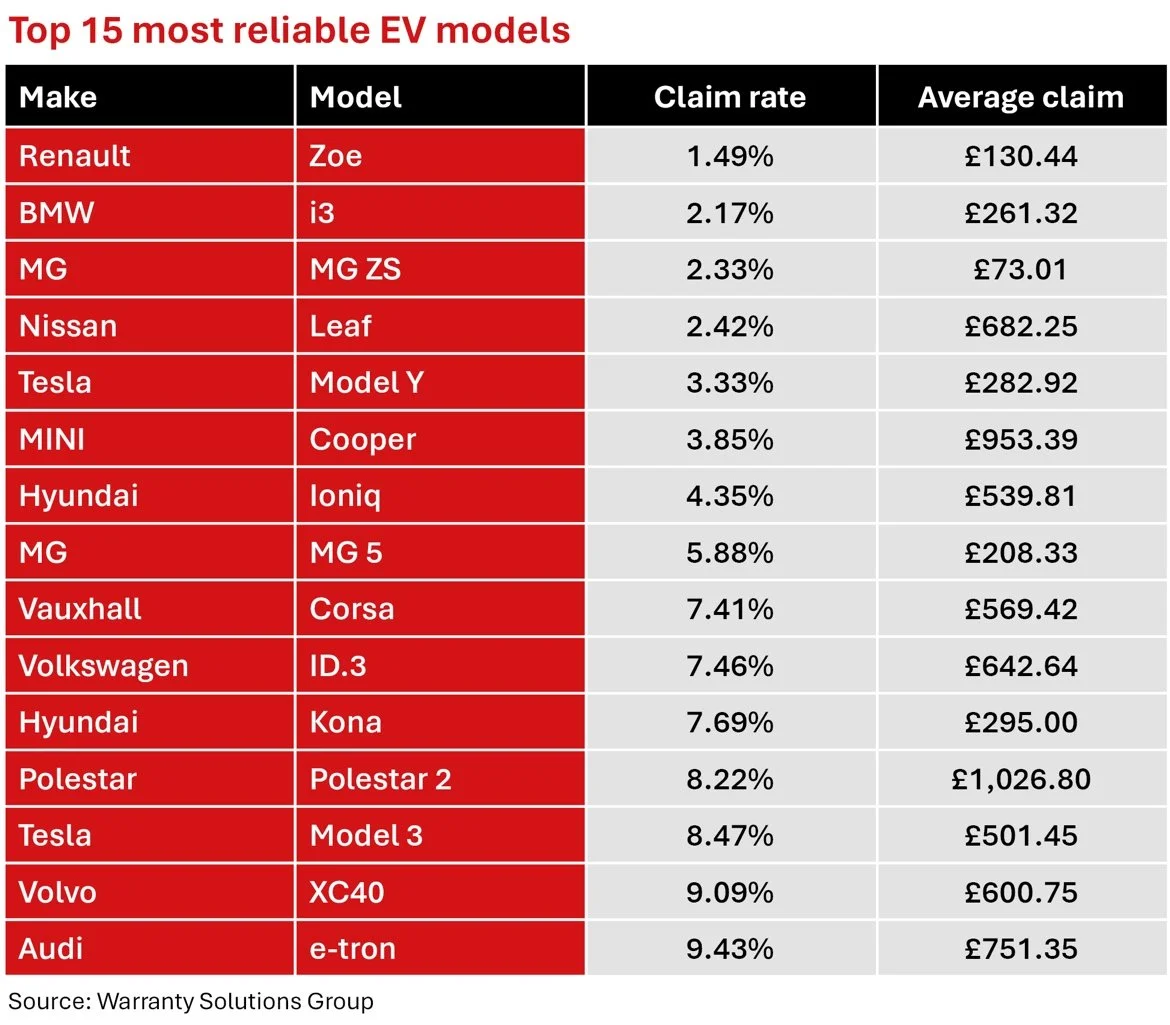
The Renault Zoe topped the rankings as the UK's most reliable used electric vehicle, recording the lowest warranty claim rate at just 1.49%. It was followed by the BMW i3 (2.17%), one of the pioneers of the modern EV market, and the MG ZS EV (2.33%), which has become one of Britain's most popular affordable electric SUVs.
Completing the top five were the Nissan Leaf (2.42%) and Tesla Model Y (3.33%), demonstrating that dependable ownership is being achieved across a broad mix of manufacturers, vehicle types and price points.
At the opposite end of the rankings, the Tesla Model S recorded the highest claim rate at 34.78%, followed by the Mercedes-Benz EQV (33.33%) and the Tesla Model X (29.17%). The contrast was striking. The Tesla Model S generated warranty claims at a rate more than 23 times higher than the Renault Zoe, reinforcing why buyers should research individual models rather than assume every electric vehicle offers the same ownership experience.
Dennis Brett, Claims Director at Warranty Solutions Group, said: "With record numbers of former company cars and leased EVs now entering the used market, motorists have a wider choice than ever before. At the same time, they're looking for independent reliability data to help them make informed purchasing decisions.
“Five years ago, the biggest questions surrounding electric vehicles were about range, charging infrastructure and battery life. Today, the conversation has evolved. Buyers want to know which models are proving the most reliable, what faults they're most likely to encounter and what repairs could cost once the manufacturer's warranty has expired.
“Perhaps the most significant finding from our research is the scale of the difference between individual models. The Renault Zoe recorded a claim rate of just 1.49%, while the Tesla Model S exceeded 34% - meaning it generated warranty claims at a rate more than 23 times higher. That demonstrates why consumers should never assume all electric vehicles offer the same ownership experience.
“The encouraging news is that many EVs are proving exceptionally dependable. However, our research also shows clear differences between individual models, making independent claims data an increasingly valuable tool for consumers. Looking beyond range and performance to understand real-world reliability and ownership costs can help buyers choose an EV with far greater confidence."
The changing cost of EV ownership
While reliability varies significantly between models, the research also shows that the cost of repairing electric vehicles is evolving as they become more mainstream.
WSG found the average labour rate across all EV claims reached £92.04 per hour, with repairs requiring an average of 2.07 labour hours. Labour now accounts for almost 30% of the average repair bill, reflecting the specialist diagnostics, software systems and high-voltage expertise increasingly required to repair modern electric vehicles.
Although EVs generally require less routine servicing than petrol or diesel vehicles, repairs increasingly involve sophisticated electronics, advanced driver assistance systems and complex software diagnostics. As a result, labour is becoming an increasingly significant contributor to overall ownership costs.
What goes wrong?
While the reliability rankings varied considerably, WSG's claims data also identified clear trends in the types of repairs being carried out.
Contrary to one of the biggest public concerns surrounding electric vehicles, high-voltage battery failures represented only a small proportion of warranty claims, accounting for just over 2% of repairs recorded during the study.
Instead, the most common warranty claim involved central locking systems, accounting for 4.29% of all EV claims, followed by charge flap actuator failures (3.57%), lower arm repairs (2.86%), parking distance control sensors, charger port faults and battery-related repairs.
The findings suggest that, as electric vehicles mature, many ownership issues increasingly resemble those experienced by petrol and diesel vehicles. Electronics, sensors, charging hardware and suspension components are now featuring more prominently within warranty claims data as EVs age and mileages increase.
One of the most significant findings concerned charger port repairs. Although they represented only 2.14% of warranty claims, they generated average repair bills of £1,881.66, making them one of the most expensive recurring repairs identified in the study.
Brett added: "There remains a misconception that battery degradation is the biggest ownership risk with used electric vehicles, but our claims data paints a much more balanced picture.
"While battery-related repairs accounted for just 2.14% of claims, we're increasingly seeing repairs involving charging systems, electrical components, sensors and vehicle electronics. In many cases, these faults can be just as disruptive for owners and, because they require specialist diagnostics, parts and technical expertise, they can also be expensive to repair.
"Our research shows that understanding how different models perform in the real world is just as important as understanding the types of faults they are likely to experience. Looking beyond headline figures such as battery range and focusing on long-term reliability and ownership costs will help consumers make more informed purchasing decisions and buy with greater confidence."
Major repairs remain expensive
While many of the most common EV faults are relatively inexpensive to repair, WSG's analysis also identified a number of high-value claims involving premium electric vehicles, highlighting the increasing complexity and cost of repairing modern electric vehicle technology.
The largest warranty claim paid during the study reached £4,801.24 following extensive battery system repairs to a Jaguar I-PACE. Other significant claims included £3,127.09 for a coolant heater repair on a Jaguar I-PACE, £3,102.36 for an electric motor repair on a Mercedes EQA and £3,051.59 for repairs to a Porsche Taycan involving the on-board charger, door lock and vehicle diagnostics.
The data also demonstrates that it is not just battery-related repairs that can generate substantial costs. A Tesla Model 3 required repairs costing £3,000 to its air conditioning compressor, tyre pressure monitoring system (TPMS) and parking distance control (PDC) sensor, while Porsche Taycan charger port repairs costing £2,995.85 and £2,054.60 highlight how faults involving specialist charging systems can result in significant repair bills.
The findings reinforce an important distinction for consumers. Claim frequency and repair severity are not always the same thing. Some vehicles experience relatively few warranty claims overall, but when major electrical, charging or battery-related components fail, repair costs can quickly run into thousands of pounds. Understanding both how often a vehicle experiences faults and the potential cost of those repairs gives buyers a much clearer picture of the long-term cost of ownership and the value of choosing the right warranty cover.
Brett concludes: "One of the key messages from our research is that consumers should look beyond headline figures such as battery range or purchase price. Understanding how individual models perform in the real world, what faults they're most likely to experience and the potential cost of repairs gives buyers a much clearer picture of long-term ownership.
"Electric vehicles have matured enormously over the past decade and many are proving exceptionally reliable. The important point is that not every model performs in the same way. Independent claims data helps separate perception from reality, giving motorists the confidence to choose a used EV that is likely to deliver dependable and affordable ownership over the long term."
About the research
The analysis is based on approximately 2,500 EV warranty claims recorded between 30 June 2025 and 1 July 2026. To ensure a fair comparison, only vehicle models with more than 50 warranty policies during the reporting period were included in the reliability rankings.
Warranty Solutions Group currently protects around 10,000 fully electric vehicles across the UK through its dealer network, direct-to-consumer platform and strategic partnerships, with that number continuing to increase as EV adoption grows.