
What if every technician could gain an extra working day every month?
The automotive aftermarket has spent years discussing the technician shortage, and with good reason. As vehicles become increasingly complex, workshops are under growing pressure to recruit, retain and develop skilled technicians capable of diagnosing and repairing ever more sophisticated vehicles.
But what if one of the biggest opportunities facing the industry isn't finding more technicians at all?
What if it's finding more time?
It sounds ambitious, but the maths is surprisingly simple. Give a technician back just 30 minutes each day and that equates to two and a half hours every week. Over the course of a month, that's more than 10 additional productive hours – effectively an extra working day from every technician on the payroll.
At a time when UK businesses are losing an average of £1,172 for every day a van is off the road, those gains quickly become commercially significant.
Yet while much of the industry's attention remains focused on attracting new talent into the sector, there is another question worth asking: are workshops making the most effective use of the technicians they already have?
Technicians are estimated to spend between 10% and 20% of their working day completing administration, repair documentation and warranty reporting. The challenge is not vehicle technology – it's workshop efficiency.
Unlocking capacity without increasing headcount
For many workshops, increasing capacity is easier said than done. While the IMI's latest Vacancy Tracker suggests overall vacancies have fallen across the automotive sector, demand remains heavily concentrated in technical roles, highlighting the ongoing challenge of sourcing experienced technicians. As a result, improving productivity remains one of the few levers workshops can directly control.
That means reducing the time spent on administration, warranty reporting, searching for technical information and duplicating data across multiple systems. And this is where technology is beginning to deliver measurable gains.
Early trials of voice-to-text workshop technology have already demonstrated what can be achieved when some of that administrative burden is removed. Examples of lengthy warranty write-ups taking more than 30 minutes to complete manually have been reduced to as little as five minutes, while technicians are able to retrieve relevant technical information and guided workflows within seconds using voice commands.
While saving 25 minutes on a single warranty report may not seem transformational, the cumulative impact across multiple technicians and multiple jobs quickly translates into meaningful workshop capacity without increasing headcount.
For workshop owners, that means more productive hours, improved workshop throughput and ultimately the ability to get vehicles back on the road faster.
Recent research found that UK businesses lose an average of £1,172 for every day a van is off the road. For customers, whether they operate a single vehicle or a national fleet, getting vehicles back into service quickly means less disruption to operations, fewer missed jobs and reduced financial loss. For workshops, reducing vehicle off-road (VOR) time improves workshop throughput, increases capacity without adding headcount, and helps deliver the faster turnaround times that customers increasingly expect, strengthening customer satisfaction and retention.
Modern vehicles need modern workshop processes
There is a certain irony within the modern aftermarket. Vehicle technology has advanced at an extraordinary pace, with technicians expected to navigate software-defined vehicles, connected systems, ADAS technologies, electrified powertrains and increasingly complex repair procedures.
Yet many of the processes surrounding vehicle repair remain stubbornly manual.
Technicians routinely move between multiple systems to find technical information. Repair notes are often recorded manually before being transferred into another platform. Warranty claims can require the same information to be entered multiple times. While each task may only add a few minutes to a job, collectively they create a significant drain on workshop capacity.
The issue is not that garages are resistant to technology. The aftermarket has consistently demonstrated its ability to adapt, whether that was diagnostics, hybrid technology, EVs or ADAS calibration. The challenge is that technology within the workshop has often been viewed as a significant investment rather than a practical tool capable of solving everyday operational problems.
The reality is that the most effective technologies are often the simplest to implement because they work alongside existing workshop processes rather than replacing them.
Technology should amplify expertise, not replace it
Perhaps the biggest misconception surrounding modern workshop technology is that it is designed to replace technical knowledge, but the reality is quite the opposite.
The most effective solutions are those that allow technicians to apply their expertise more efficiently.
They reduce repetitive administration, make technical information easier to access and help workshops utilise specialist knowledge more effectively when complex repairs arise.
Importantly, this isn't about relying on generic AI tools or scraping information from the internet. Workshop technology needs to be built around manufacturer-approved information, workshop-specific workflows and the realities of modern vehicle repair.
The goal is not to replace experience – it’s to make experience more accessible.
Addressing the skills shortage differently
Technology also has an important role to play in tackling one of the industry's biggest challenges: access to expertise.
Many independent workshops have experienced the frustration of a complex fault that requires specialist knowledge beyond the capability of the technician standing in front of the vehicle. Historically, that often meant waiting for a master technician, escalating the repair or extending vehicle downtime.
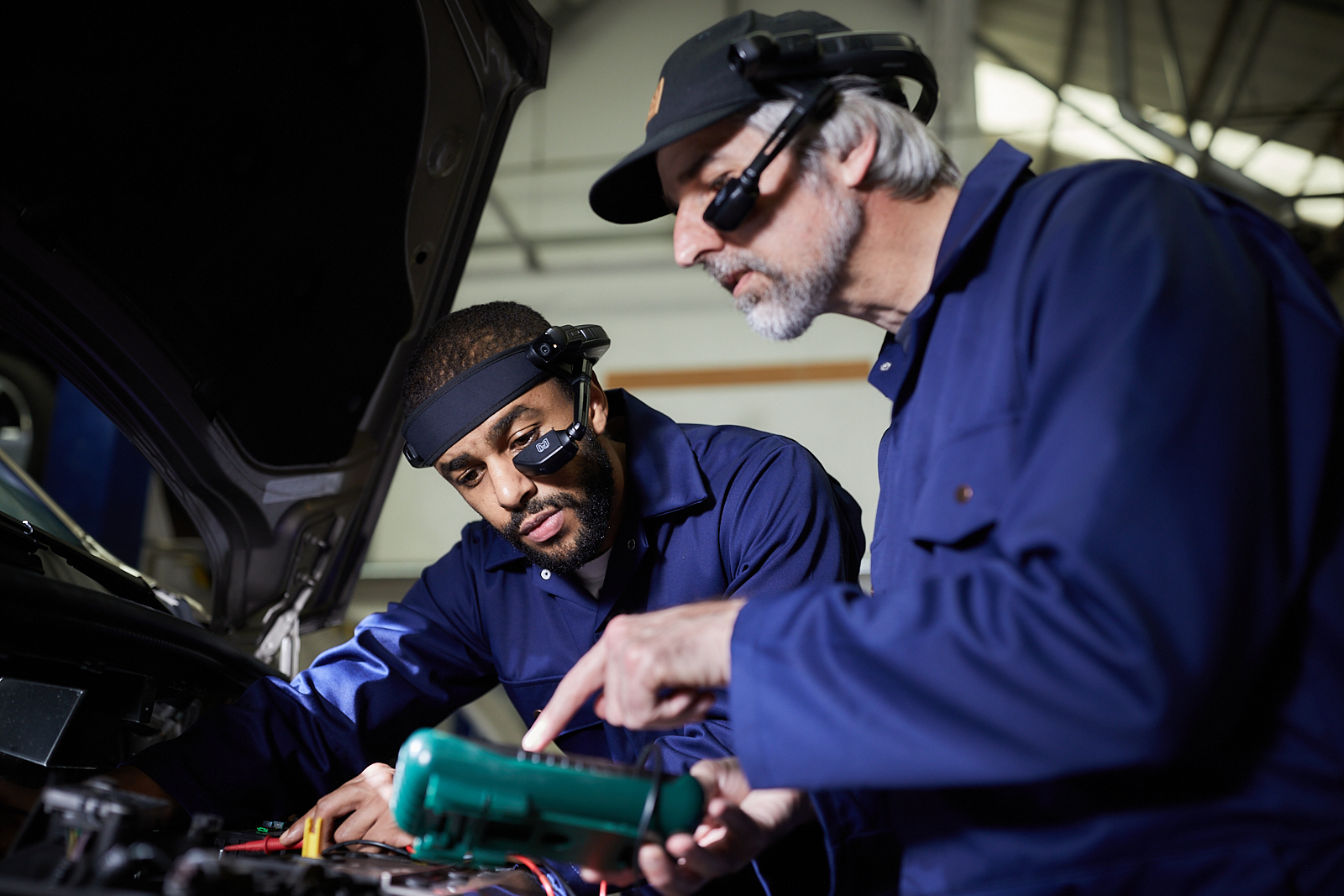
Today, technologies such as Assisted Reality are already proving what is possible in practice. By enabling technicians to connect directly with remote master technicians while remaining hands-free on the job, workshops can access specialist support exactly when it is needed. One commercial vehicle network reported a 93% increase in repair efficiency using this approach, helping technicians diagnose and repair vehicles more quickly while reducing delays.
In a market where experienced technicians remain in short supply, making expertise instantly available may prove just as valuable as recruiting additional people. For garages this represents an opportunity not simply to overcome skills shortages, but to make better use of the skills already available within the business.
The workshops that thrive will be the most productive
The next generation of vehicles entering the aftermarket will place even greater demands on workshops. Software-defined vehicles connected systems and increasingly sophisticated diagnostics will require technicians to process more information than ever before.
In that environment, productivity will become a key differentiator. The workshops that succeed will not necessarily be those with the largest teams or the biggest premises. They will be the businesses that find ways to reduce wasted time, streamline processes and maximise the expertise available within their workforce.
The industry will always need more technicians. But perhaps the bigger opportunity lies in unlocking more time from the talented technicians already working within our workshops.
For many businesses, that opportunity may be closer than they think.