
Workshops Warned EV Coolant Bleeding Could Lead to Costly Rework
A1 ADAS Group says manufacturer procedures risk being overlooked when coolant systems are disturbed during EV and hybrid repairs
Workshops are being urged to pay closer attention to manufacturer coolant bleeding procedures on electric and hybrid vehicles after A1 ADAS Group encountered cases where incorrect bleeding resulted in vehicle recovery and avoidable rework.
Jamie Willis, Business Development Director at A1 ADAS Group, said the company is carrying out more EV and hybrid coolant bleeds through its mobile technician service.
He recently came across a nearly new hybrid Mercedes where the coolant had been topped up following repair work, but the required bleeding procedure had not been completed correctly before the vehicle was returned to the customer.
A warning light subsequently appeared and the vehicle had to be recovered to the repairer, leaving the customer stranded and requiring alternative transport. The vehicle then needed further work to rectify the problem.
Jamie said: “On the face of it, bleeding a coolant system sounds like a relatively simple job, which is probably part of the problem. On many EVs and hybrids it isn't simply a case of topping up the coolant and allowing it to circulate.
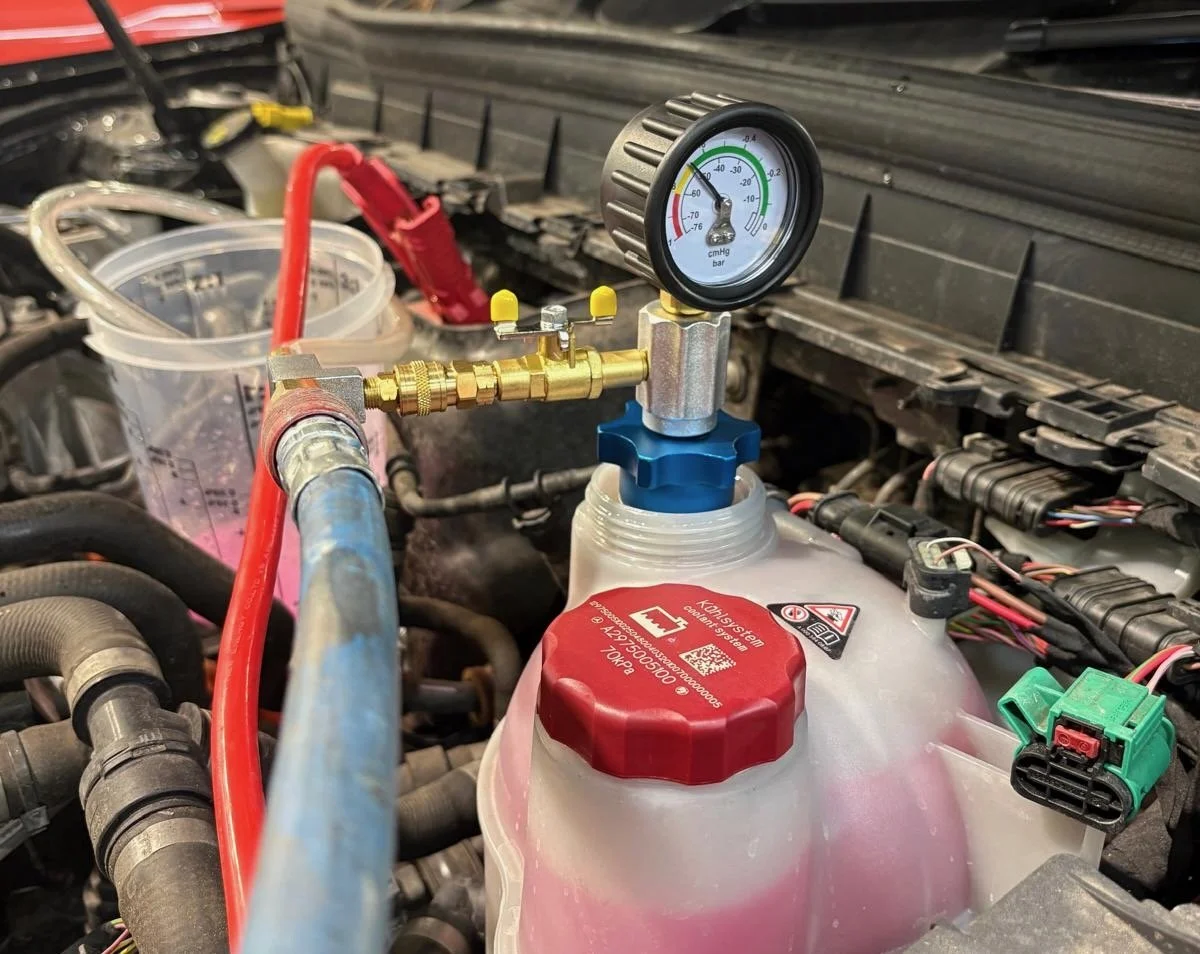
“You have to follow the OE method for that specific vehicle. Depending on the manufacturer, that can involve an OE diagnostic tool alongside specialist pressure or vacuum filling equipment. Diagnostic equipment may also be needed to operate pumps and valves within the cooling circuit.
“Simply topping up the coolant and relying on gravity doesn't necessarily remove air trapped within the system. We've had vehicles where the bleeding process has had to be carried out several times before all the air has been removed.”
While coolant bleeding is familiar territory for mechanical workshops, A1 says EV and hybrid systems can introduce additional vehicle-specific procedures and diagnostic requirements.
Jamie continued: “A warning light and a vehicle coming back still means an unhappy customer, recovery costs, lost workshop time and rework. At the more serious end, an incorrectly filled cooling system can result in overheating and potentially much greater damage.
“The key is identifying at the estimating and repair-planning stage whether a specific coolant bleeding procedure is required, so it becomes part of the repair rather than something discovered after the vehicle has gone back to the customer.”