
IAAF puts forward case for minimum MOT fee and PN testing in new white paper
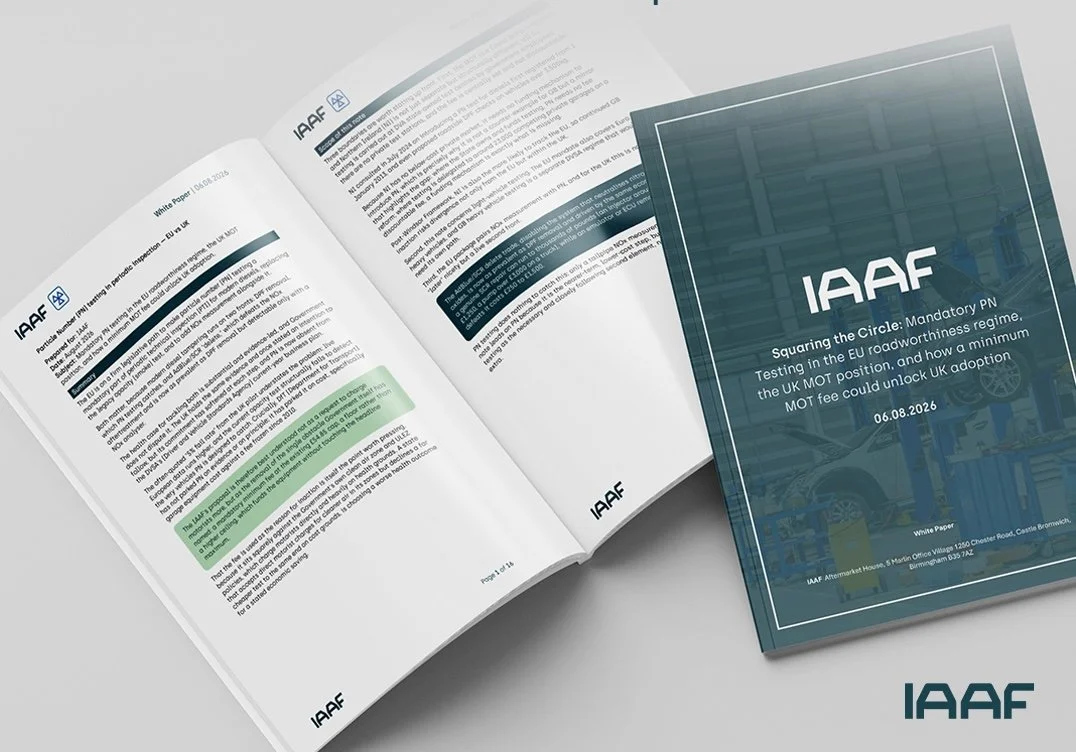
The Independent Automotive Aftermarket Federation (IAAF) is calling on Government to introduce a statutory minimum MOT fee to enable the long-awaited introduction of particulate number (PN) and NOx emissions testing for diesel vehicles – without increasing the maximum price motorists can be charged.
In a new White Paper, Squaring the Circle: Mandatory PN Testing in the EU Roadworthiness Regime, the UK MOT Position, and How a Minimum MOT Fee Could Unlock UK Adoption, the federation argues that the Department for Transport’s (DfT) reluctance to introduce PN and NOx testing has never been due to concerns over the technology or evidence supporting it, but instead centres on the cost of implementation.
The IAAF believes that introducing a statutory minimum MOT fee, fixed at the existing £54.85 maximum charge, would remove that barrier. While the current price cap would remain unchanged, garages would no longer be able to discount MOTs to £20-£30, restoring the income needed to invest in the specialist equipment required for PN and NOx testing.
Mark Field, Chief Executive of the IAAF, said: “Inflation alone would justify an MOT fee of around £95 today. We are not asking for that. We are asking for a floor at the price that has already been frozen since 2010, so that the garages carrying out these tests properly can afford the equipment they need. This isn’t about increasing costs for motorists; it’s about removing the only reason Government itself has consistently given for delaying implementation.”
The White Paper highlights how the Government’s position on PN testing has steadily weakened in recent years, moving from a commitment to introduce the technology, to reviewing whether it should be implemented, before disappearing entirely from the latest DfT business plan.
The IAAF also points to what it describes as a contradiction in current Government policy. While concerns over the cost to motorists have delayed the introduction of more effective MOT emissions testing, central and local government continue to operate Clean Air Zones and London’s Ultra Low Emission Zone (ULEZ), where drivers of non-compliant vehicles can be charged up to £12.50 per day to improve air quality.
Poor air quality remains one of the UK’s biggest public health challenges, contributing to an estimated 43,000 premature deaths each year. Research from Imperial College London has also shown a significant reduction in air pollution-related deaths in London following the introduction of ULEZ and other clean air measures.
At the same time, the federation warns that the current MOT emissions regime is no longer fit for purpose when it comes to identifying modern diesel emissions tampering. Existing smoke opacity testing and visual inspections can be bypassed through illegal software-only diesel particulate filter (DPF) deletes or by modifying the filter housing while maintaining its original appearance.
According to the IAAF, a vehicle with a tampered or failed DPF can emit particulate pollution equivalent to between 10 and 20 compliant vehicles, with PN testing representing the only reliable method of detecting these failures during an MOT.
Field continued: “If protecting public health justifies charging motorists to drive into a city, it surely justifies introducing the test that identifies the highest-polluting vehicles wherever they are driven. It makes little sense to penalise motorists for emissions while failing to introduce the technology capable of detecting those vehicles during the annual MOT.”
The federation also believes that introducing PN testing would significantly reduce the illegal DPF delete market by removing the loopholes that currently allow modified vehicles to pass an MOT. It is also urging Government to commit to NOx testing as a second phase, tackling illegal AdBlue and SCR emulator deletes in line with new European roadworthiness requirements due to be introduced between 2027 and 2030.
As part of the White Paper, the IAAF has put forward six recommendations to the Department for Transport and the Driver and Vehicle Standards Agency (DVSA):
Commit to a firm implementation date for PN testing within the GB MOT.
Adopt the EU PN testing methodology and limit of 250,000 particles/cm³ for post-2013 (Euro 5b) diesel vehicles and newer.
Introduce a statutory minimum MOT fee at the existing £54.85 cap to fund the equipment required, without increasing the maximum price motorists can be charged.
Retain the previously modelled two-year implementation period to allow garages sufficient time to invest in equipment.
Coordinate implementation with Northern Ireland to ensure a consistent UK-wide testing regime.
Commit to introducing NOx measurement as a second phase alongside PN testing.
Field concluded: “The evidence is settled and the public health case has already been made. The only remaining barrier is funding. A statutory minimum MOT fee removes that obstacle without increasing the maximum price motorists pay, while giving garages the confidence to invest and helping Government deliver cleaner air without further delay.”